Higher Chance of Pregnancy
Donor eggs may offer improved chances of pregnancy because the eggs generally come from younger donors with good ovarian reserve.


The egg donation process consists of two important phases, each carefully planned and monitored by fertility specialists. In the first phase, ovarian stimulation is performed to encourage the development of multiple mature eggs in the donor’s ovaries. During this stage, regular monitoring is carried out to assess follicle growth and ensure that the eggs are developing appropriately. Once the eggs reach the required stage of maturity, the second phase begins. The mature eggs are retrieved from the donor through a surgical procedure called Transvaginal Ultrasound Aspiration. After retrieval, the eggs are carefully evaluated and prepared for fertilization in the laboratory.
Donor eggs can provide an important option for women who may have difficulty conceiving using their own eggs.
Donor eggs may offer improved chances of pregnancy because the eggs generally come from younger donors with good ovarian reserve.
Donor eggs are carefully screened and selected according to established fertility and medical criteria.
Egg donation may provide an option for couples who have experienced repeated IVF failure or reduced ovarian reserve.
Egg donors undergo medical evaluation and screening before participating in the egg donation program.
The donor egg program provides an option for women who may not be able to conceive using their own eggs. Donated eggs are fertilized with sperm in the laboratory and the resulting embryo may then be transferred to the recipient's uterus.

An option for women who may not be able to conceive using their own eggs.
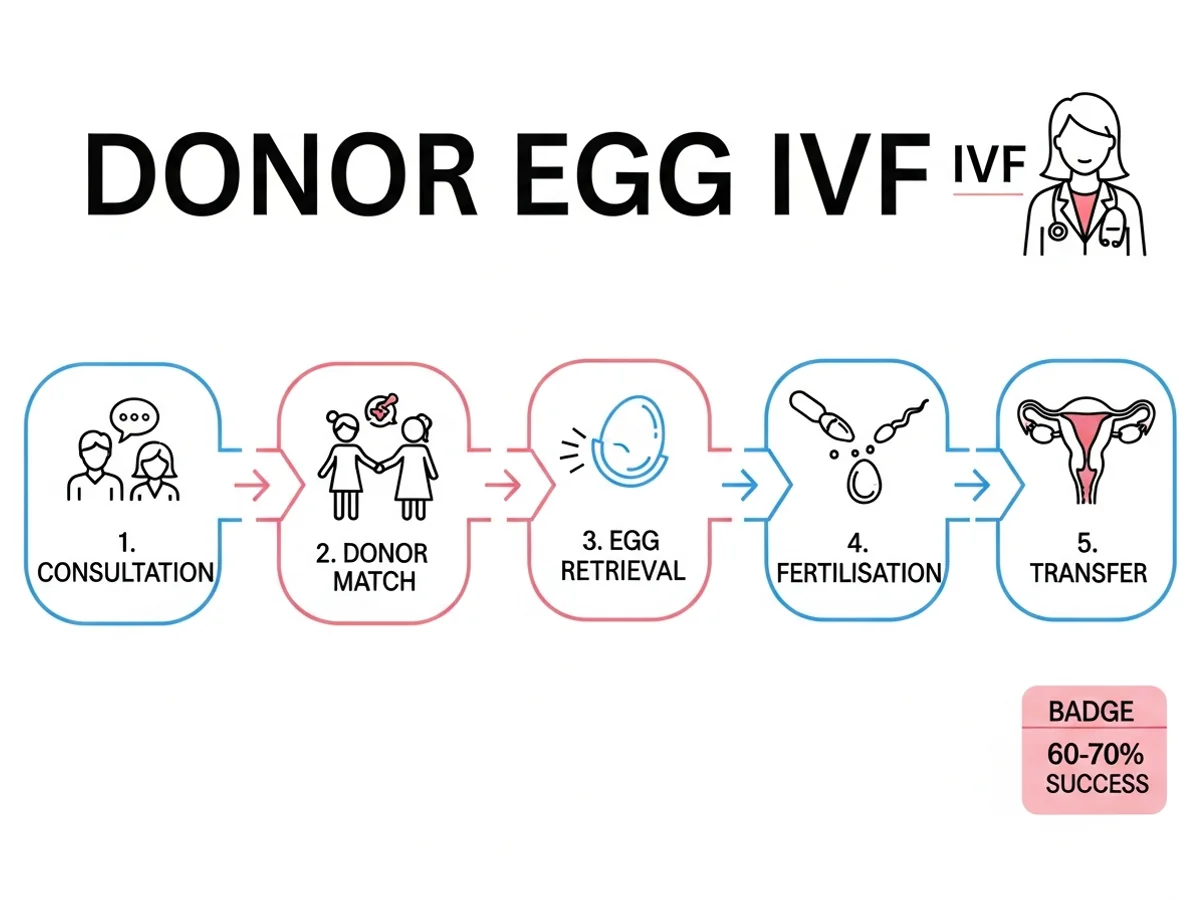
Donor eggs may be recommended in specific fertility situations where using the woman's own eggs may have a lower chance of successful treatment.
During an IVF cycle with egg donation, the egg donor is stimulated to develop multiple mature eggs. The eggs are retrieved and fertilized with sperm in the laboratory. The resulting embryos are then prepared for transfer to the recipient.
A suitable egg donor is selected according to the applicable medical and program criteria.
The donor receives medication to stimulate the ovaries and develop multiple mature eggs.
The mature eggs are collected using an ultrasound-guided egg retrieval procedure.
Retrieved eggs are fertilized with sperm in the laboratory to create embryos.
A suitable embryo is transferred into the recipient's uterus after appropriate preparation.
After embryo transfer, pregnancy is monitored through follow-up consultations and appropriate tests under specialist care.
Egg donation is generally performed under careful medical supervision. However, like other fertility treatments, some risks may be associated with the process.

Care throughout your treatment
Transfer of more than one embryo may increase the possibility of twins or multiple pregnancy.
Pregnancy following fertility treatment may require appropriate monitoring throughout the pregnancy.
Couples may experience emotional and psychological considerations when choosing donor eggs.
Your fertility specialist will guide you through the treatment and explain any individual risks.
The success rate of IVF with donor eggs depends on multiple factors. Donor egg treatment may provide a higher chance of pregnancy in selected patients because donor eggs are generally obtained from younger women with good ovarian reserve.
The quality and development of the embryo can influence implantation and pregnancy.
The health and condition of the uterus and endometrium are important for embryo implantation.
Careful preparation and timing of embryo transfer are important parts of the treatment.
Maternal age, reproductive health and other individual factors may influence treatment outcomes.
The cost of IVF with donor eggs varies depending on the treatment plan, donor-related expenses, medications, laboratory procedures and other clinical requirements.
Donor screening and medical evaluation
Donor stimulation and monitoring
Egg retrieval procedure
Laboratory fertilization and embryo development
Recipient endometrial preparation
Embryo transfer procedure
Important to know
The final cost may vary according to the individual treatment plan and services required during the IVF cycle.
Quick Reference
Patients should discuss the complete treatment plan and estimated cost with the fertility specialist before starting treatment.
Find answers to common questions about donor eggs, IVF treatment, donor selection, success rates and embryo transfer.
Egg donation is a fertility treatment in which eggs from a suitable donor are retrieved and fertilized with sperm in the laboratory to create embryos for transfer to the recipient.
Donor eggs may be considered for women with reduced ovarian reserve, advanced maternal age, repeated IVF failure or certain genetic conditions.
The success rate depends on several individual and treatment-related factors including donor egg quality, embryo quality and recipient uterine health.
Egg donors undergo appropriate medical evaluation and screening before being considered for an egg donation program.
The donor egg retrieval and recipient's endometrial preparation are coordinated so that the resulting embryo can be transferred at the appropriate time.
Yes. Donor eggs can be fertilized with sperm through IVF laboratory procedures and the resulting embryo can be considered for embryo transfer.
Take the first step towards parenthood with compassionate care, expertise, and support tailored to your unique needs.