
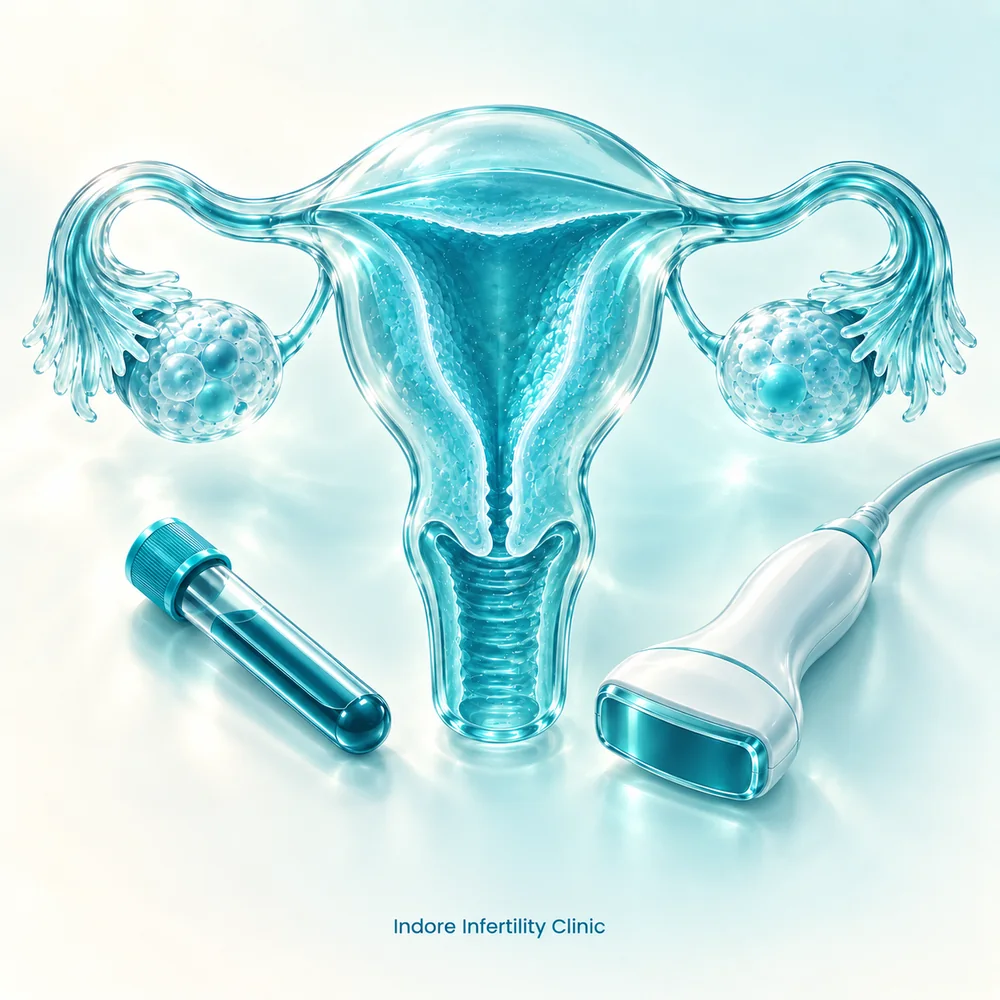
What are InFertility Tests for Female?
Female infertility tests help identify factors that may affect a woman’s ability to conceive. The evaluation may include a detailed medical and menstrual history, pelvic ultrasound, ovarian reserve and hormone testing, and assessment of the uterus and fallopian tubes when clinically indicated. These tests help assess ovulation, egg reserve, reproductive hormones, and the health of the reproductive organs. Based on the results, fertility specialists can identify potential concerns and recommend a suitable treatment plan.
The first step in overcoming infertility is to get mentally ready to visit an Infertility Specialist who would perform a thorough Infertility Evaluation. A standard fertility evaluation includes physical exams, blood workup and medical as well as sexual histories of both partners.
Couples should be prepared to respond to some very personal questions like “frequency of intercourse” etc during the Infertility Evaluation. It helps to be very candid and frank with your Doctor as the course of treatment will be dependent upon the results of the evaluation.
The results of the evaluation helps the Infertility Specialist(s) to determine the cause of infertility which can either be due to Female Partner or Male Partner. Listed below are our Infertility Evaluation Services.
- Hormone Studies
- Follicular Monitoring
- Endometrial Assessment
- Endometrial Biopsy
- Hysterosalpingogram (HSG)
- Hysterosonography
- Hysteroscopy
- Laparoscopy
- Hormone Studies (Male)
- Varicocele Assessment
- ASA
- DNA Fragmentation Index
- Erectile Dysfunction
- Ejaculatory Dysfunction
- STD Diagnosis
- Male Well Being Assessment
Commonly Asked Questions About InFertility Tests for Female
Find answers to common questions about female infertility evaluation, ultrasound, ovarian reserve, HSG and fertility testing.
Female infertility evaluation may include a detailed medical and menstrual history, transvaginal ultrasound, ovarian reserve assessment and evaluation of the fallopian tubes when indicated. Additional tests depend on the patient's individual history and findings.
A transvaginal ultrasound uses an ultrasound probe placed in the vagina to obtain detailed images of the uterus and ovaries. It can help identify uterine abnormalities, ovarian cysts and developing follicles.
AMH or Anti-Müllerian Hormone is a blood test that can be used as a marker of ovarian reserve. It provides information about ovarian response but does not by itself determine whether a woman can become pregnant.
Antral follicle count is performed using transvaginal ultrasound to count small follicles in the ovaries. It is one of the ultrasound-based markers used to assess ovarian reserve.
HSG stands for hysterosalpingography. It is an X-ray based investigation that uses contrast material to examine the uterine cavity and determine whether the fallopian tubes are open.
Not necessarily. The need for tubal testing depends on the patient's history, symptoms, age, previous treatment and the fertility specialist's assessment.
Ultrasound cannot by itself diagnose every cause of infertility. It is an important part of fertility evaluation and can provide information about the uterus, ovaries, follicles and some structural abnormalities.
No. Ovarian reserve tests such as AMH provide information about ovarian reserve and treatment response, but they do not by themselves determine whether a woman can or cannot conceive.
If the initial fertility evaluation does not identify a clear cause, the fertility specialist reviews the complete history of both partners and discusses appropriate next steps based on the individual situation.
For women younger than 35, infertility evaluation is generally considered after 12 months of trying to conceive without pregnancy. For women aged 35 or older, evaluation is generally considered after 6 months, with earlier evaluation appropriate in some circumstances.
Yes. Earlier evaluation may be appropriate when there is a known medical condition or history associated with infertility, or when the fertility specialist considers earlier assessment appropriate.
There is no single test that can completely determine fertility. Female fertility evaluation looks at several factors including ovulation, ovarian reserve, the uterus and fallopian tubes, along with the fertility evaluation of the male partner when applicable.
Ready to begin your journey?
Take the first step towards parenthood with compassionate care, expertise, and support tailored to your unique needs.