
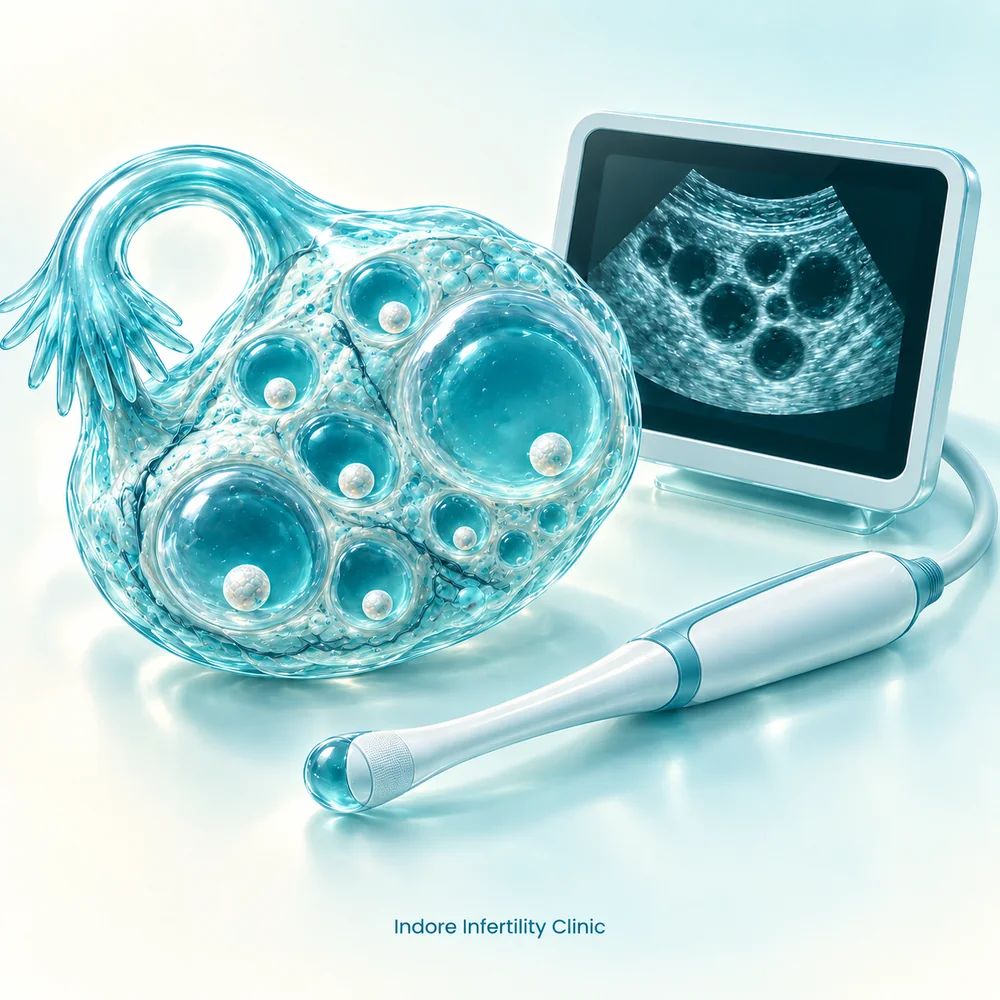
Follicular Monitoring / Ovulation Study
Follicular Monitoring, also known as an Ovulation Study, is an ultrasound-based test used to track the growth and development of ovarian follicles during the menstrual cycle. A series of scans helps monitor follicular growth, endometrial thickness, and the timing of ovulation. It helps fertility specialists assess whether ovulation is occurring normally and identify the optimal time for natural conception or fertility treatment. It can also help guide ovulation induction and other assisted fertility procedures.
Follicular Monitoring is also known as Ovulation Study or Ovulation Profile.
The ovaries in women contain numerous eggs in immature form. In each menstrual cycle, some eggs are recruited under the effect of hormones, and they start growing in size. After few days of growth, there is usually just one of them that matures and eventually is released. This process of release of the mature egg is called ovulation.
When this whole process is assessed over a period of few days by means of sonography, it is called follicular monitoring or ovulation study.
Follicular Monitoring or Ovulation study is usually done between days 12-16 of the menstrual cycle. Day one is day the menses start. At times follicular study or monitoring may be commenced earlier or may finish later depending on the duration of menstrual cycles and regularity of ovulation.
When is Follicular Monitoring advised?
Primarily follicular monitoring is advised to detect ovulation. On ultrasound the growing follicle is tracked and monitored serially. At some point of time, usually between Day 12-16 the follicle will become irregular and disappear indicating that ovulation has occurred. It is performed in the following conditions:
(a) To confirm that ovulation is occurring normally and for timed intercourse.
(b) To monitor the response of Ovarian Stimulation drugs during IUI, IVF/ICSI.
Key questions (1 of 4)
How is Follicular Monitoring done?
Ovulation study is best performed by transvaginal ultrasound. In some cases, abdominal USG can be performed but it is not optimal. Transvaginal ultrasound although inconvenient is more accurate and does not need a full bladder to be performed.
Key questions (2 of 4)
When is follicular monitoring test advised?
Follicular monitoring is done to check for the growth of follicles in your ovaries. It is done in following cases:
- To check for ovulation – with or without any treatment.
- In cases of ovulation induction – to look for response to treatment.
- Ovarian stimulation in IVF cycles – to observe the response of stimulation and to select the right time for oocyte pickup.
- To plan IUI or timed intercourse.
Key questions (3 of 4)
How does follicular monitoring help in fertility treatment?
Follicular monitoring helps keep track of the treatment response in fertility treatment in women. It helps in the following:
- Deciding the day for procedures like IUI, ovum pickup.
- It helps in adjusting the dose of certain medications when undergoing IVF or ovulation induction.
- It helps in predicting the possible outcomes in ovulation induction and IVF.
- It helps in predicting the risks like OHSS (ovarian hyperstimulation syndrome) in IVF cycles.
- It helps in selecting the embryo transfer day in natural cycle frozen embryo transfer.
Key questions (4 of 4)
What will be reported at the end of Follicular Monitoring?
The following are reported at the end of Follicular Monitoring
- Number of growing follicles in each ovary
- Rate of growth of follicles
- Whether ovulation is taking place or not
- Endometrial Thickness during various stages of the cycle
Commonly Asked Follicular Monitoring Questions
Find answers to common questions about follicular monitoring, ultrasound scans, ovulation, follicle growth, preparation, alternatives and cost.
Follicular Monitoring is also known as Ovulation Study or Ovulation Profile. It is the assessment of the process of follicle growth and ovulation over a period of few days by means of sonography.
Primarily follicular monitoring is advised to detect ovulation. It is used to confirm that ovulation is occurring normally and for timed intercourse, and to monitor the response of ovarian stimulation drugs during IUI, IVF and ICSI.
Ovulation study is best performed by transvaginal ultrasound. In some cases, abdominal USG can be performed but it is not optimal. Transvaginal ultrasound is more accurate and does not need a full bladder.
A follicular scan usually takes 5–10 minutes.
Transvaginal Sonography may be done every day or every alternate day depending on the rate of growth of the follicle.
Follicular monitoring is preferably done by transvaginal sonography. It can cause some discomfort, but usually it is not painful.
No, you do not need to hold urine for follicular monitoring. As it is usually done by transvaginal sonography, you should pass urine and empty your bladder before the sonography. Only if an abdominal sonography is needed, you might be asked to hold urine.
Yes, you can eat before follicular monitoring. No, it is not a fasting test.
Follicular monitoring is done to check the growth of follicles in your ovaries. It is done to check for ovulation with or without treatment, in cases of ovulation induction, during ovarian stimulation in IVF cycles, and to plan IUI or timed intercourse.
Follicular monitoring is the assessment of ovarian follicle development over days to observe their growth and development during a woman's menstrual cycle. It is done by ultrasonography. The size of follicles in the ovaries is checked at each scan and noted down on a chart to observe their growth.
During a menstrual cycle, Day 1–5 usually shows multiple small follicles measuring 6–8 mm. On Day 6–7, at least one dominant follicle is usually around 10 mm. During Day 8–12, the dominant follicle grows approximately 2–3 mm each day and reaches around 20 mm by the 11th–12th day. During Day 12–16, the mature dominant follicle ruptures and its remaining shell is seen as the corpus luteum.
Follicular monitoring can be performed several times during a cycle. Day 2–6 may be used to look for antral follicle count and cysts, Day 11/12 to look for dominant follicle growth, and Day 12–16 to look for maturation and rupture. If ovulation is not seen till Day 16, monitoring can be extended for 1–2 days.
Ready to begin your journey?
Take the first step towards parenthood with compassionate care, expertise, and support tailored to your unique needs.