Advanced Maternal Age
The clinic states that PGT-A may be considered for maternal age 35 or above when accompanied by additional factors.


Pre-Implantation Genetic Testing (PGT) is a genetic test performed on a few cells obtained from an embryo, usually at the Day 5 or Day 6 blastocyst stage, before the embryo is transferred into the uterus. Earlier terms such as PGD and PGS have largely been replaced by the broader term PGT. The purpose is to identify specific genetic or chromosomal abnormalities and help select embryos for transfer based on the type of testing performed. PGT is performed as part of an IVF cycle and can provide additional genetic information about embryos before a transfer decision is made. The type of testing used depends on the patient's medical history, genetic findings and the specific condition being evaluated.
PGT is not intended as a routine test for every IVF patient. The clinic recommends considering the specific type of PGT according to maternal age, fertility history, chromosome findings and known inherited genetic disorders.
The clinic states that PGT-A may be considered for maternal age 35 or above when accompanied by additional factors.
Severe male factor infertility, including conditions such as azoospermia and OATS, is listed as a co-existing factor when counseling for PGT-A.
Patients with recurrent implantation failure may be considered for PGT-A after appropriate clinical evaluation.
Multiple pregnancy losses are listed among the factors that may lead to counseling for PGT-A.
Patients or couples with known structural chromosome rearrangements such as reciprocal or Robertsonian translocations may be counseled for PGT-SR.
PGT-M may be considered when one of the parents has a single-gene disorder, there is a family history of such a disorder or there is already an affected child.
A previous pregnancy or live-born child affected by aneuploidy or a known inherited genetic disorder can be an important reason for genetic counseling and PGT consideration.
Patients or couples with a relevant personal or family genetic history may be advised to discuss PGT with an IVF specialist and genetic counselor before treatment.
The clinic broadly classifies Pre-Implantation Genetic Testing into PGT-A, PGT-SR and PGT-M. Each type addresses a different genetic or chromosomal concern.
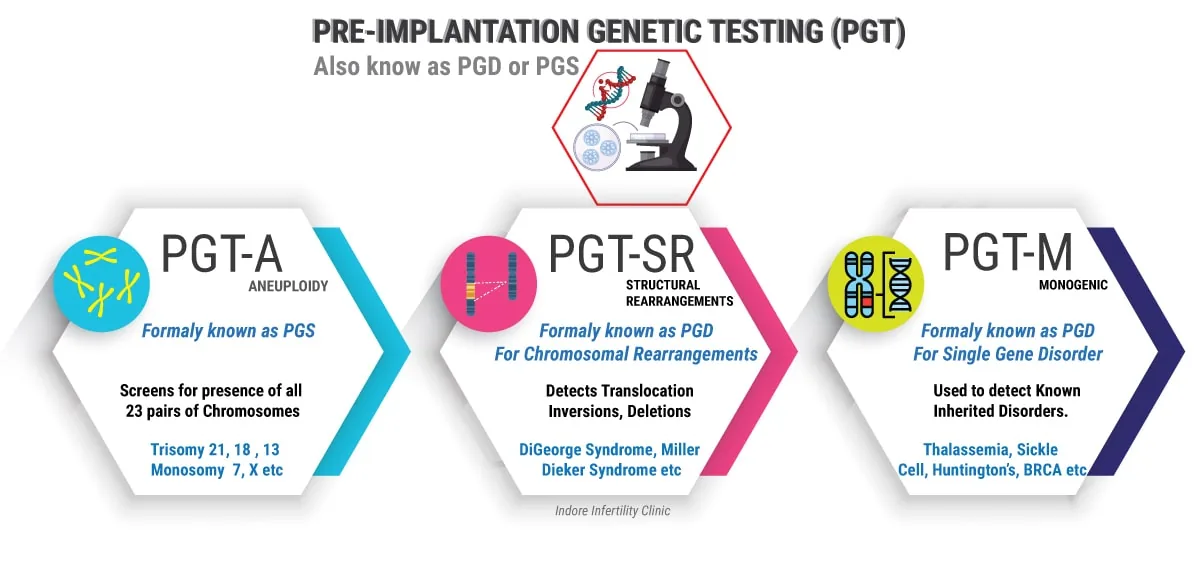
Pre-Implantation Genetic Testing for Aneuploidies
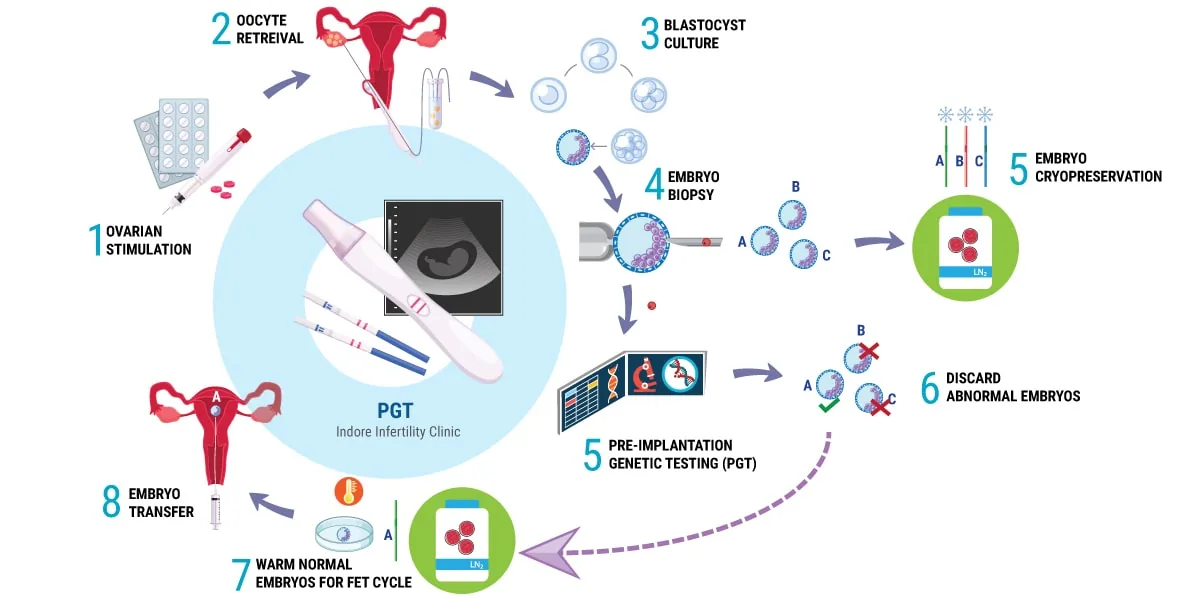
From Ovarian Stimulation to Embryo Transfer
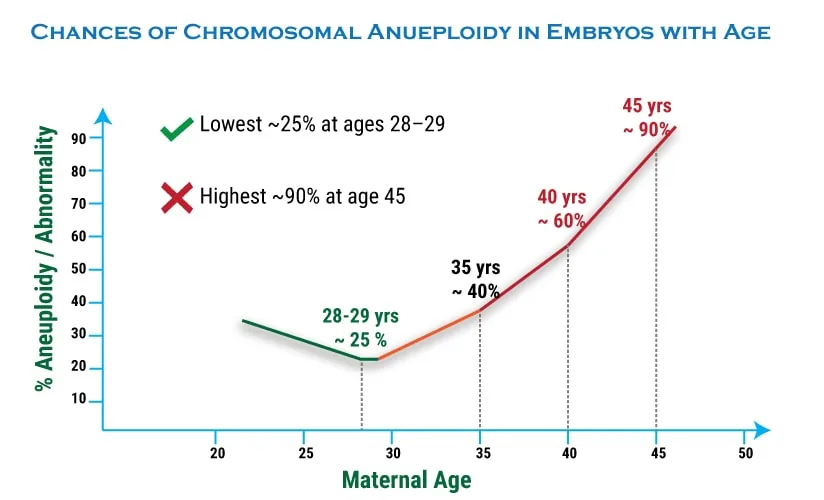
Chromosomal Abnormality and Age
PGT is performed in conjunction with an IVF cycle. Embryos are created through IVF, cultured until the blastocyst stage, biopsied and then the extracted cells are sent to a genetic laboratory for testing. The biopsied embryos are cryopreserved while the genetic testing is performed.
The IVF cycle begins with ovarian stimulation and follicular monitoring to develop multiple follicles.
Oocytes are retrieved through ovum pick-up and fertilized in the IVF laboratory to create embryos.
The embryos are cultured in the laboratory until they develop into blastocysts, usually around Day 5 or Day 6.
When a suitable blastocyst is available, a few cells are removed from the trophectoderm layer using a biopsy technique.
The extracted cells are safely transported to a genetic laboratory. The clinic describes NGS as a molecular genetic technique used to analyse all 23 pairs of chromosomes.
The blastocysts that undergo biopsy are tagged and cryopreserved while the genetic laboratory processes the biopsy samples.
The clinic states that PGT results usually take approximately 1–3 weeks depending on the type of testing requested. PGT-A and PGT-SR are listed as approximately 7–10 days, while PGT-M may take up to 3 weeks.
After the PGT results are available, the patient can be prepared for a frozen embryo transfer cycle and an embryo selected according to the genetic test results may be transferred.
PGT involves embryo biopsy and genetic testing, so it is not a completely risk-free or universally recommended procedure. The clinic highlights embryo mosaicism, possible misdiagnosis, the invasive nature of biopsy and cost as important considerations.
PGT should be considered after discussion with an IVF specialist and, where appropriate, a genetic counselor.
Embryo biopsy involves removing cells from the blastocyst and therefore requires a highly trained embryology team.
The clinic explains that an embryo can contain a mixture of normal and abnormal cells, a condition known as mosaicism, which can complicate interpretation.
The clinic discusses false-positive and false-negative results as limitations that need to be considered when interpreting PGT.
The biopsied cells come from the trophectoderm and may not always perfectly represent the inner cell mass that develops into the fetus.
Because embryo biopsy is invasive, the clinic notes that there can be a possibility of embryonic damage and that the procedure requires skilled technicians.
The clinic identifies the cost of embryo biopsy and genetic testing as an important disadvantage of PGT.
PGT does not guarantee a genetically or medically normal baby because the test only evaluates the genetic abnormalities for which the embryo has been tested.
The clinic source emphasises that PGT should not automatically be used simply because the technology is available. The decision should be based on the individual clinical and genetic situation.
PGT provides genetic information about embryos before transfer. Depending on the type of PGT performed, the results can help the fertility team select embryos that meet the criteria for transfer.
Screens for numerical chromosome abnormalities involving the 23 pairs of chromosomes.
Evaluates embryos when a parent has a known structural chromosome rearrangement.
Tests embryos for a specific known monogenic or single-gene disorder.
Biopsied embryos are cryopreserved while testing is performed, and suitable embryos may subsequently be considered for frozen embryo transfer.
Genetic counseling can be particularly important when a patient or close family member has a known inherited genetic disorder.
The cost of PGT depends on both the embryo biopsy procedure and the genetic laboratory testing.
PGT includes charges for performing embryo biopsy.
Genetic laboratory testing of the biopsied embryo cells is charged separately as part of the PGT cost.
The cost can vary according to the number of blastocysts that are tested.
PGT charges are over and above the normal IVF/ICSI blastocyst transfer cycle cost.
The clinic recommends discussing the charges after the patient's case has been reviewed by the doctor.
Important to know
The source page does not provide one fixed PGT price because the cost has fixed and variable components and depends on the number of blastocysts tested.
Cost Reference
PGT cost = Embryo Biopsy charges + Genetic Testing charges. Charges are additional to the normal IVF/ICSI Blastocyst Transfer Cycle.
Find answers to common questions about Pre-Implantation Genetic Testing, embryo biopsy, PGT-A, PGT-SR, PGT-M, testing time, cost and genetic counseling.
PGT stands for Pre-Implantation Genetic Testing. It is a test performed on a few cells extracted from an embryo, usually at the Day 5 or Day 6 blastocyst stage, to evaluate specific genetic or chromosomal abnormalities before embryo transfer. PGD is an older term that is now commonly included under PGT, particularly for monogenic disorders.
According to the clinic, patients may be counseled for PGT-A when maternal age is 35 or above along with factors such as severe male factor infertility, recurrent implantation failure, multiple pregnancy losses, or a previous pregnancy or live-born child with aneuploidy.
PGT-A is Pre-Implantation Genetic Testing for Aneuploidies. It is used to screen for numerical chromosome abnormalities involving the 23 pairs of chromosomes.
PGT-SR is Pre-Implantation Genetic Testing for Structural Rearrangements. It is used when a parent has a known structural chromosome rearrangement such as a reciprocal translocation, Robertsonian translocation, inversion, insertion or deletion.
PGT-M is Pre-Implantation Genetic Testing for Monogenic Disorders. It may be considered when a parent has a single-gene disorder, there is a family history of such a disorder, or there is already an affected child.
The clinic states that embryo biopsy is usually performed on Day 5 or Day 6 when the embryo has developed into a fully expanded blastocyst. Around 7–10 cells are extracted from the trophectoderm layer.
The clinic states that PGT results usually take approximately 1–3 weeks depending on the type of test. PGT-A and PGT-SR are listed as taking around 7–10 days, while PGT-M may take up to 3 weeks.
The clinic describes blastocyst trophectoderm biopsy as a commonly used approach in which approximately 7–10 cells are removed from the outer layer. However, it also emphasises that embryo biopsy is an invasive procedure and should be performed by a highly trained technician.
No. PGT does not guarantee a baby without any genetic abnormality. The clinic explains that PGT is designed to test particular genetic or chromosomal abnormalities rather than every possible genetic condition.
No. The clinic strongly states that PGT is not for everyone and should not automatically be used as a general screening tool. The decision should be based on the individual clinical and genetic situation.
According to the clinic source, PGT is performed in conjunction with an IVF cycle because embryos need to be created in the laboratory, cultured to the appropriate stage and biopsied before genetic testing.
The clinic states that blastocysts undergoing biopsy are tagged and cryopreserved while the extracted cells are sent to the genetic laboratory. After results are available, a suitable embryo may be selected for a frozen embryo transfer cycle.
Take the first step towards parenthood with compassionate care, expertise, and support tailored to your unique needs.