Persistently Thin Endometrium
Enhances the Endometrial Thickness.


PRP stands for Platelet-Rich Plasma. It is a plasma fraction obtained from the patient’s own (autologous) blood, in which the concentration of platelets is approximately 4–5 times higher than normal blood levels. Platelets are tiny blood cells that play an important role not only in blood clotting but also in tissue repair, healing, growth, and regeneration. PRP contains a high concentration of various growth factors and bioactive proteins that can support the body’s natural healing process.
PRP Therapy has been recently tried in the following areas:
Enhances the Endometrial Thickness.
PRP Therapy has been tried in cases of recurrent implantation failure and recurrent pregnancy loss.
PRP Therapy has been tried with the aim of improving ovarian reserve.
PRP Therapy has been tried in cases where endometrial blood flow is sub-optimal.
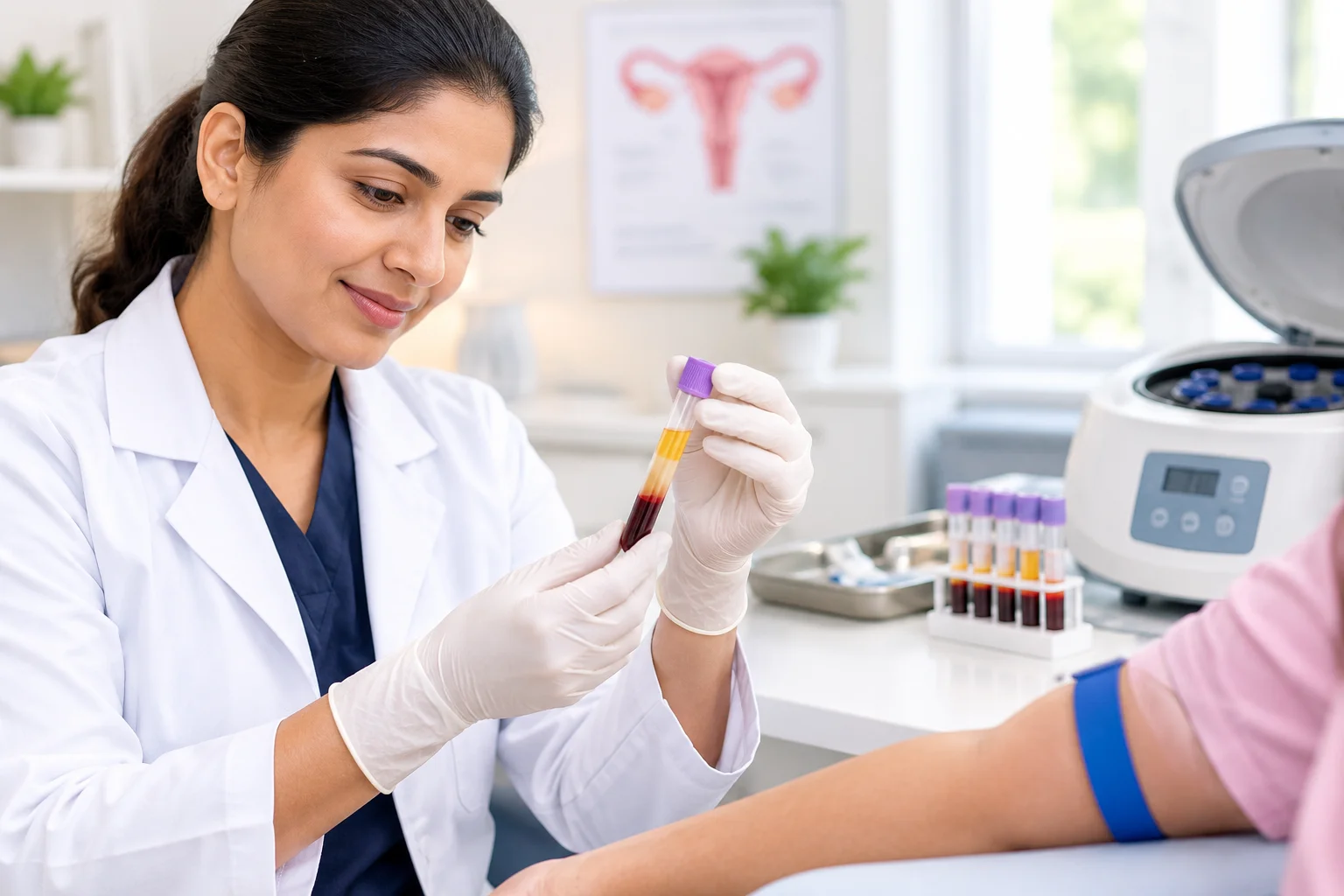
PRP sample preparation involves drawing the patient's blood and using centrifugation to isolate and prepare the platelet-rich plasma.
Around 10 to 15 ml of blood is drawn from the patient in special tubes.
The content of the tube is centrifuged at a very high speed to isolate RBCs, plasma and platelets.
Once the platelets are isolated, the separated platelets along with some leukocytes are transferred to another tube and centrifuged again to prepare PRP.
Prepared PRP of approximately 0.5 to 1 ml is then immediately infused into the endometrial cavity.
The PRP sample is prepared using appropriate sterile procedures to maintain sample quality and reduce contamination risks.
Trained laboratory technicians can assist with PRP preparation as part of comprehensive fertility treatment and clinical care.
PRP sample is prepared from the patient's own blood, hence risk of infection, cross contamination and immunogenic reaction is negligible.
Care throughout your treatment
The provided content states that the risk of infection is negligible because the PRP sample is prepared from the patient's own blood.
The provided content describes the risk of cross contamination as negligible when PRP is prepared from the patient's own blood.
Because PRP is prepared from the patient's own blood, the provided content describes the risk of immunogenic reaction as negligible.
Your fertility specialist will guide you regarding the suitability of PRP Therapy and your individual treatment plan.
PRP Therapy may be considered in selected infertility cases based on individual clinical factors and treatment history.
PRP Therapy has been tried in patients with persistently thin endometrium.
PRP may be considered in selected cases of recurrent implantation failure.
PRP Therapy has also been tried in cases of premature ovarian failure with the aim of improving ovarian reserve.
Your fertility specialist will determine whether PRP Therapy is appropriate for your individual treatment plan.
The cost of PRP Therapy may depend on the individual treatment plan and clinical requirements.
Consultation and assessment based on the patient's individual fertility condition.
Preparation of PRP sample from the patient's own blood.
PRP procedure and infusion into the endometrial cavity.
Important to know
The final cost may vary depending on the individual treatment plan and clinical requirements.
Quick Reference
Please refer to the clinic's Treatment Service Quick Reference Chart for current treatment cost details.
Find answers to common questions about PRP therapy, preparation, safety, endometrial thickness and infertility treatment.
PRP stands for Platelet-Rich-Plasma. It is prepared from the patient's own blood and contains a higher concentration of platelets than normal plasma.
PRP Therapy has been tried for conditions such as persistently thin endometrium, recurrent implantation failure and premature ovarian failure.
Around 10 to 15 ml of blood is drawn and processed using centrifugation to isolate and prepare platelet-rich plasma.
According to the provided content, trained laboratory technicians can prepare PRP samples as part of comprehensive care.
Prepared PRP is loaded into an IUI catheter and infused into the endometrial cavity under ultrasound guidance.
The provided content states that PRP therapy should be tried in recurrent IVF/ICSI failures when thin endometrium is persistently noted or endometrial blood flow is sub-optimal.
The PRP sample is prepared from the patient's own blood, so the provided content describes the risk of infection, cross contamination and immunogenic reaction as negligible.
According to the provided content, endometrial scratching may be reserved for selected patients and may be combined with PRP in certain IVF or IUI cycles.
It is described as an outpatient procedure similar to an endometrial biopsy or PRP. It may cause slight pain or discomfort.
The cost may vary depending on the individual treatment plan and clinical requirements.
Take the first step towards parenthood with compassionate care, expertise, and support tailored to your unique needs.