Before Cancer Treatment
Sperm freezing can preserve fertility in men undergoing surgeries such as orchidectomy or before chemotherapy or radiotherapy for cancer.

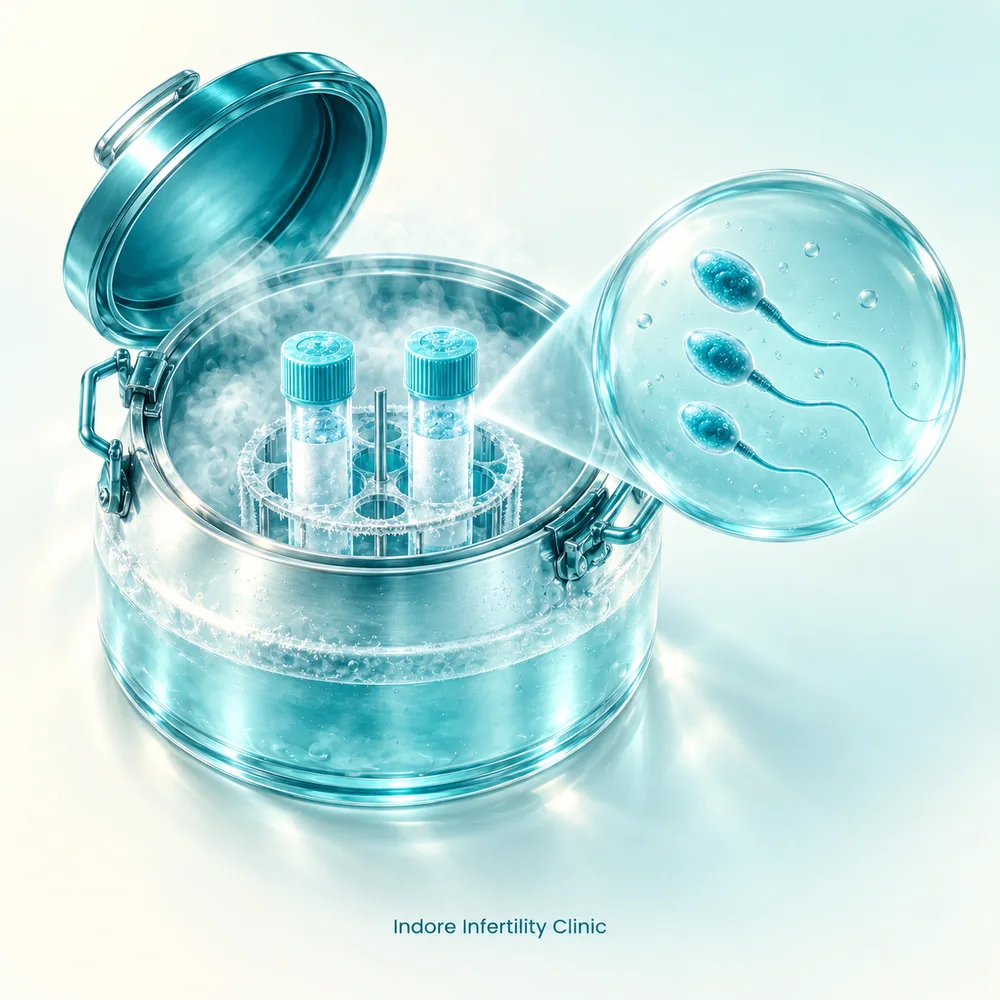
Sperm Freezing is also known as Sperm Cryopreservation, Sperm Banking or Semen Cryopreservation. It is a fertility preservation technique in which sperm is collected, analysed and frozen for future use. The process allows sperm to be stored safely for a period of time and used later when required for fertility treatment. Sperm freezing may be recommended before certain medical treatments, surgeries or fertility procedures, or when a backup sperm sample may be useful. Depending on the individual fertility plan, cryopreserved sperm can later be used for treatments such as IUI, IVF or ICSI. It provides an option for preserving male fertility and gives patients greater flexibility when planning future reproductive treatment.
Sperm freezing may be recommended for fertility preservation, treatment planning, backup samples and selected fertility procedures.
Sperm freezing can preserve fertility in men undergoing surgeries such as orchidectomy or before chemotherapy or radiotherapy for cancer.
Sperm freezing may be considered when sperm count is low and falling or when sperm quality is steadily deteriorating despite therapeutic measures.
Sperm cryopreservation is routinely performed in IVF or IVF-ICSI cycles as a backup sample when the male partner may be unavailable or unable to provide a sample during oocyte retrieval.
Sperm can be frozen in cases where the male partner is regularly away during the female partner's ovulation days.
Sperm freezing can be useful when the male partner is unable to provide a sample on demand, including situations where anxiety makes sample collection difficult.
Sperm freezing is used for intrauterine insemination using donor sperm.
Sperm obtained through TESA, PESA or Micro TESE can be cryopreserved for future IVF-ICSI cycles, avoiding the need to repeat an invasive procedure.
Sperm freezing can help preserve reproductive options for men who may need fertility treatment in the future or who may face circumstances that could affect their ability to provide sperm later.
The sperm freezing process involves medical evaluation, required blood tests, sample collection, laboratory analysis and cryopreservation.

Blood tests for HIV, HBsAg and HCV are taken before collection of the sample.
A fresh semen sample is produced after 2-3 days of abstinence.
The sample is analysed before it is frozen and the report is shared on the same day.
The processed sample is frozen for future fertility treatment or preservation needs.
A few simple preparations can help make the sperm freezing process smoother and better coordinated with your fertility preservation plan.
Before the freezing process, your doctor explains the sperm freezing procedure and the reason for cryopreservation.
Blood tests for HIV, HBsAg and HCV are taken before collection. Other tests may be advised depending on the situation.
A fresh semen sample is produced after 2-3 days of abstinence before the sample is analysed and frozen.
The semen sample is analysed before being frozen and the report is shared on the same day.
Repeated samples may be required depending on the reason for which the sperm is being cryopreserved.
According to the source page, there are no known medical risks of semen cryopreservation.
Semen cryopreservation has no known medical risks according to the source page.
The source page states that there are no known medical risks of semen cryopreservation.
Blood tests for HIV, HBsAg and HCV are taken before collection of the sample.
The sample is analysed before being frozen and the report is shared on the same day.
Your fertility specialist can explain the sperm freezing process and any situation-specific considerations.
Cryopreserved sperm can provide a stored sample for future fertility treatment when required.
Frozen sperm can be used as part of future IVF or IVF-ICSI treatment.
Frozen sperm can be used during IUI when the male partner is unavailable during ovulation days.
Cryopreserved donor sperm can be used in IUI with donor sperm.
Sperm obtained through TESA, PESA or Micro TESE can be frozen for future IVF-ICSI cycles.
Understanding the cost of sperm freezing can help you plan your fertility preservation journey with greater clarity.
Sperm freezing is performed after the required medical evaluation and sample collection.
Blood tests and laboratory analysis form part of the preparation process.
Repeated samples may be required depending on the purpose of cryopreservation.
The source page provides a Quick Reference Chart for the treatment cost.
Important to know
The source page does not state a specific numerical cost in the visible page content. It directs patients to the Quick Reference Chart for the cost of Sperm Freezing or Semen Cryopreservation.
Quick Reference
Please refer to the Quick Reference Chart for the current cost of Sperm Freezing or Semen Cryopreservation.
Find answers to common questions about sperm freezing, sperm cryopreservation, fertility preservation, sample collection and future use.
Take the first step towards parenthood with compassionate care, expertise, and support tailored to your unique needs.