
Experiencing miscarriage is one of the most devastating experiences a couple can face. When it happens repeatedly, the emotional toll becomes unbearable. If you’ve experienced two or more consecutive miscarriages, you’re not alone—approximately 1-2% of couples experience recurrent miscarriage (also called recurrent pregnancy loss). The heartbreaking truth is that many of these couples are told to simply ‘try again,’ without proper investigation or support.
At Indore infertility clinic, we take recurrent miscarriage seriously. We understand that behind every miscarriage is a devastating loss and that couples deserve answers, compassion, and solutions. Modern IVF with advanced testing offers genuine hope to overcome recurrent miscarriage and achieve healthy, lasting pregnancies.
Understanding Recurrent Miscarriage
Recurrent miscarriage is defined as three or more consecutive pregnancy losses before 20 weeks of gestation. Some clinics define it as two losses (especially if the woman is over 35), but the standard medical definition is three losses. It’s important to understand that miscarriage is heartbreakingly common—approximately 15-20% of all recognized pregnancies end in miscarriage. However, recurrent miscarriage is much rarer and often points to an identifiable cause that can be treated.
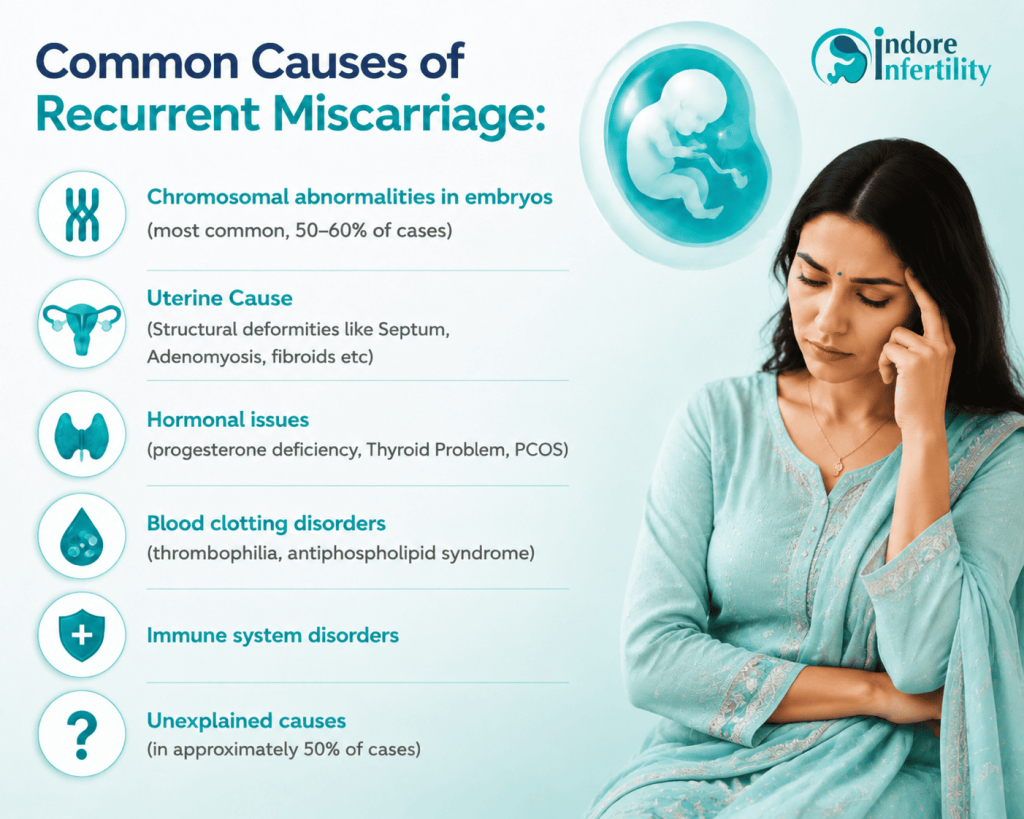
Common Causes of Recurrent Miscarriage:
- Chromosomal abnormalities in embryos (most common, 50-60% of cases)
- Uterine structural problems (septate uterus, fibroids, polyps)
- Hormonal issues (progesterone deficiency, thyroid problems)
- Blood clotting disorders (thrombophilia, antiphospholipid syndrome)
- Immune system disorders
- Unexplained causes (in approximately 50% of cases)
The encouraging news is that with proper investigation at our Indore infertility clinic, we can identify the cause in about 50% of couples with recurrent miscarriage. And when we identify the cause, we can treat it.
The Role of Age in Recurrent Miscarriage
Age is one of the most important factors influencing miscarriage risk. As a woman gets older, especially after 35, the likelihood of chromosomal abnormalities in embryos increases. These chromosomal errors are a common reason why pregnancies may not progress. For example, miscarriage risk is generally around 10–15% in the mid-20s but rises significantly with age, reaching 40–50% or higher by the mid-40s.
In many cases of recurrent miscarriage, particularly in older women, the underlying issue is not a specific disease but age-related changes in egg quality and embryo genetics. This means that even with normal test results, the risk may still be driven by embryo-related factors.
In such situations, IVF with preimplantation genetic testing (PGT-A) may be considered as an option to help identify chromosomally normal embryos before transfer. While this approach may reduce the risk of miscarriage in selected patients, especially with advancing age, it is not routinely required for everyone and should be individualized based on clinical context.
👉 Straight take:
Age is often the biggest driver here. IVF with PGT-A can help in selected cases, but it’s a tool, not a blanket solution.
Comprehensive Testing for Recurrent Miscarriage
Before recommending IVF, we conduct thorough testing to identify the underlying cause. Here’s what our Indore infertility clinic evaluates:
1. Genetic Testing
Karyotype testing of both partners identifies possible chromosomal abnormalities that could be passed to embryos. Approximately 3-5% of couples with recurrent miscarriage have a chromosomal abnormality in one partner (such as a balanced translocation).
2. Uterine Evaluation
Transvaginal ultrasound assesses uterine shape and identifies fibroids or polyps. Hysteroscopy (a small camera inserted into the uterus) allows direct visualization and treatment of problems. About 15% of women with recurrent miscarriage have a uterine abnormality that can be surgically corrected.
3. Blood Tests
Thyroid function (TSH, free T4), prolactin levels, and progesterone are checked. Autoimmune testing includes antinuclear antibodies (ANA), anticardiolipin antibodies, and lupus anticoagulant. Blood clotting screening identifies thrombophilia (inherited or acquired clotting disorders).
IVF with PGT-A: The Game-Changer for Recurrent Miscarriage
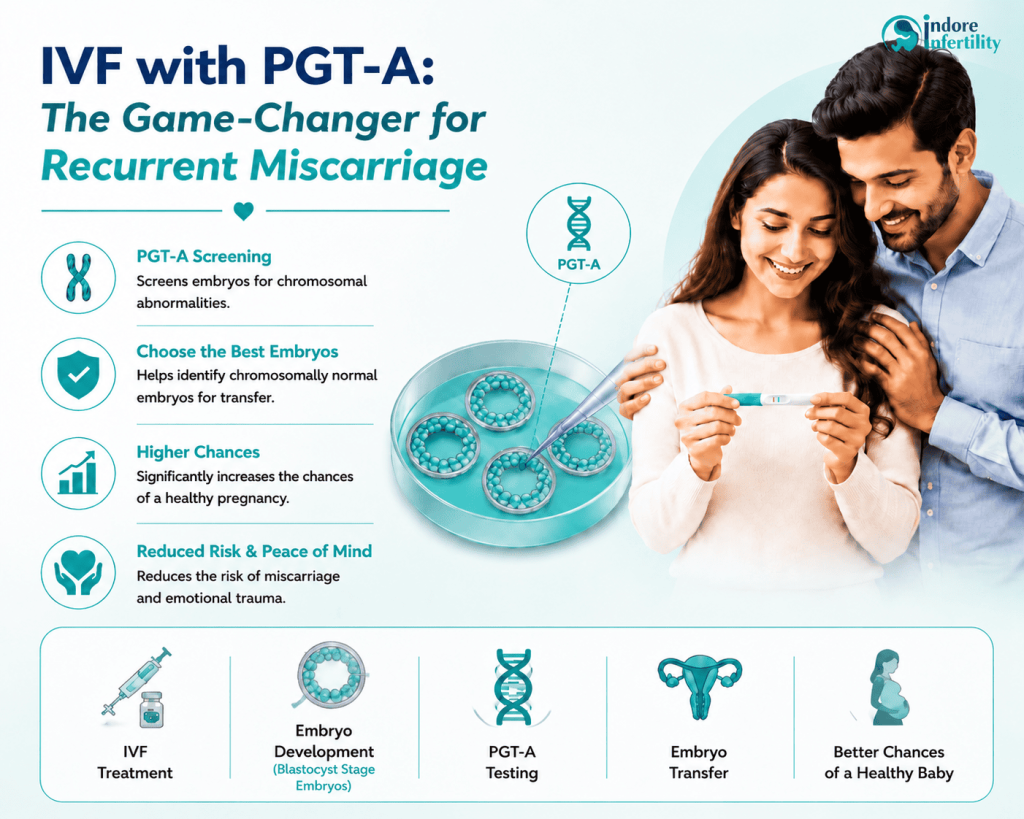
The most significant advancement in treating recurrent miscarriage due to chromosomal abnormalities is Preimplantation Genetic Testing (PGT) or PGT-A, formerly called PGD. This technology allows us to screen embryos for chromosomal abnormalities before transfer, dramatically reducing miscarriage rates.
How PGT Works:
- IVF cycle proceeds normally—eggs are retrieved and fertilized
- On day 5-6, embryos develop to blastocyst stage
- A small sample of cells from the trophectoderm of the blastocyst is biopsied from each embryo
- Genetic material is analyzed to check for chromosomal abnormalities
- Only chromosomally normal (euploid) embryos are transferred
The impact is remarkable: while natural conception at age 40 has only a 5-10% chance of producing a chromosomally normal embryo, with PGT-A screening, success rates increase to 50-70% depending on how many chromosomally normal embryos are available.
Treatment Approaches for Different Causes
If Cause: Chromosomal Abnormalities
Solution: IVF with PGT (₹2,75,000-₹3,50,000). Success rates with chromosomally normal embryo transfer: 60-75% per cycle. This is the most effective solution for age-related chromosomal problems.
If Cause: Uterine Abnormalities
Solution: Hysteroscopic surgery to correct the problem (₹30,000-₹50,000), followed by IVF or natural conception attempt. Success rates improve dramatically after structural correction—miscarriage rates decrease from 40-50% to 10-15%.
If Cause: Hormonal Issues
Solution: Thyroid medication if needed, progesterone supplementation, and possibly IVF with better hormone control. Many women with hormonal issues can conceive naturally or with IUI after treatment.
If Cause: Blood Clotting Disorders
Solution: Anticoagulation therapy (aspirin, heparin) during pregnancy. When properly treated, miscarriage rates drop from 70-80% to 15-20%. Couples with antiphospholipid syndrome often have excellent outcomes with proper treatment.
If Cause: Unexplained
Solution: When no clear cause is found for recurrent pregnancy loss, most leading international guidelines suggest a simple but important approach: don’t rush into aggressive treatments. Many couples in this situation still have a good chance of a successful pregnancy naturally with the right support and monitoring. IVF with genetic testing (PGT) is not routinely recommended for everyone, as it has not been shown to consistently improve outcomes in unexplained cases. It may be considered in specific situations, such as increasing maternal age or when there is a strong suspicion of chromosomal issues, but for most couples, careful follow-up, reassurance, and optimizing overall health remain the mainstay of management.
How IVF Helps Recurrent Miscarriage
For many couples with recurrent miscarriage, the biggest barrier isn’t just biology, it’s fear. After going through repeated losses, trying naturally again can feel emotionally overwhelming, with constant anxiety about another miscarriage. IVF offers a more structured and closely monitored path to pregnancy. Every step, from egg development to embryo transfer, is planned and tracked, which often gives couples a greater sense of control and reassurance during the process.
In addition, many patients with recurrent pregnancy loss are in their mid-30s or older, where the risk of chromosomal abnormalities in embryos increases. In such cases, IVF combined with preimplantation genetic testing (PGT-A) can be considered to help identify embryos that are chromosomally normal before transfer. While this is not required for everyone, in selected patients it may improve the chances of a successful pregnancy and reduce the likelihood of another miscarriage.
Success Rates for Recurrent Miscarriage with IVF
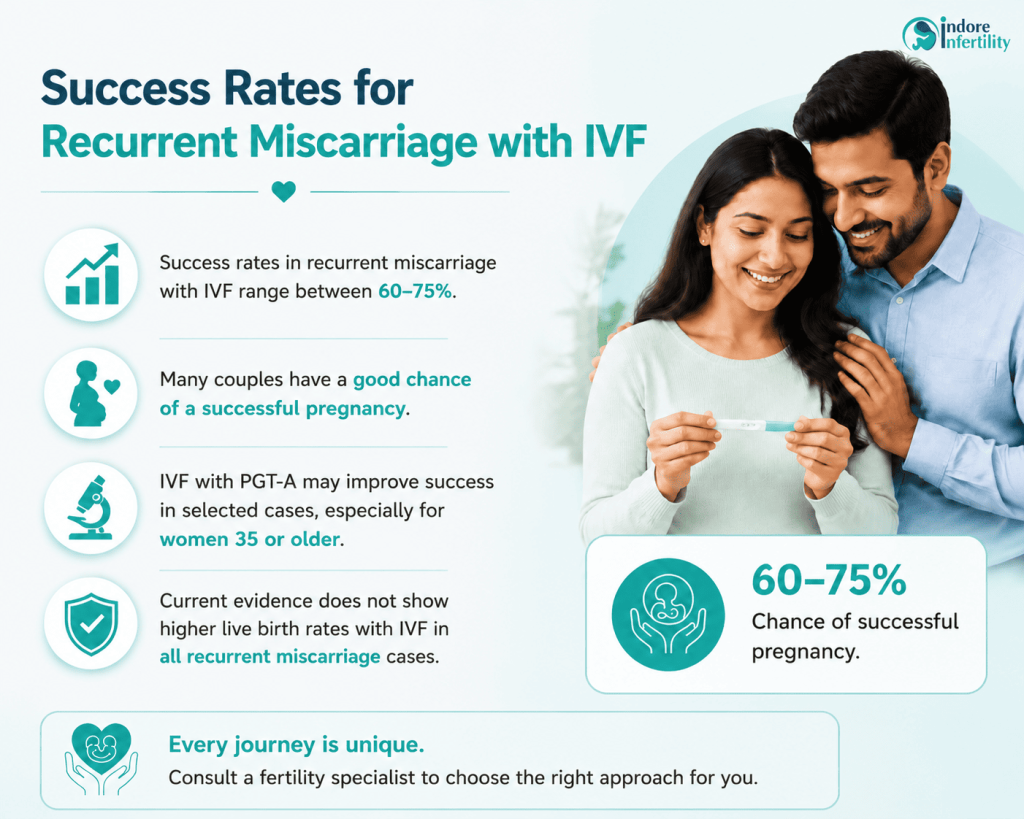
Success rates in recurrent miscarriage need to be interpreted carefully, because outcomes depend heavily on the woman’s age, the number of previous miscarriages, and whether the figure is being quoted per pregnancy, per embryo transfer, or per treatment cycle started. In unexplained recurrent pregnancy loss, many couples still have a good chance of a successful pregnancy naturally, often in the range of 60 to 75% overall. IVF with PGT-A can be considered in selected cases, especially in women aged 35 or older, because it may lower the risk of transferring aneuploid embryos and may reduce the chance of another miscarriage. However, current evidence does not support saying that IVF with PGT-A routinely raises live birth rates to 70 to 80% in all recurrent miscarriage patients.
Cost of Treatment in Indore
Standard IVF Cycle: ₹1,75,000 – ₹2,00,000. IVF with PGT: ₹2,75,000 – ₹3,25,000. Diagnostic testing for miscarriage: ₹15,000 – ₹30,000. Hysteroscopy and surgical correction: ₹35,000 – ₹50,000. Anticoagulation therapy during pregnancy: ₹5,000 – ₹15,000 per month.
Emotional Support and Counselling
Recurrent miscarriage is emotionally devastating. Each loss triggers grief, self-blame, and anxiety about future pregnancies. At our Indore infertility clinic, we provide comprehensive psychological support including individual counseling, support groups, and couples therapy. We understand that addressing emotional health is just as important as addressing medical issues.
FAQ About Recurrent Miscarriage and IVF
Recurrent miscarriage is relatively uncommon, affecting about 1–2% of couples, so it does deserve proper evaluation. However, it’s important not to panic. Even after multiple miscarriages, many couples still go on to have a successful pregnancy. In fact, depending on factors like age and previous history, the chances of a future live birth can still be around 60–70% or higher, even without major intervention.
In about half of the cases, a clear cause can be identified, such as genetic factors, uterine abnormalities, or certain medical conditions. In the remaining cases, no obvious cause is found. The good news is that with the right evaluation, supportive care, and targeted treatment when needed, the overall outlook remains reassuring for most couples.
IVF can reduce uncertainty, but it does not eliminate the risk of miscarriage. When IVF is combined with genetic testing (PGT-A), embryos selected for transfer are more likely to be chromosomally normal, which can lower the chance of miscarriage, especially in women of higher age. However, it’s important to understand that miscarriage can still occur even with a chromosomally normal embryo, as other factors like uterine conditions, hormonal balance, or underlying medical issues may also play a role.
Current evidence suggests that miscarriage rates after transfer of a chromosomally normal embryo are generally lower than with untested embryos, but not zero. Identifying and managing any known contributing factors, such as uterine abnormalities or conditions like antiphospholipid syndrome, can further improve the chances of a successful pregnancy.
👉 In simple terms: IVF with PGT-A can reduce risk in selected cases, but it cannot guarantee that another miscarriage will not happen.
Age is one of the most important factors, especially after 35, because the risk of chromosomal abnormalities in embryos increases significantly with age. This is a common reason for miscarriage, even in women with no other underlying problem.
That said, recurrent miscarriage is not always due to age alone. In some cases, other factors such as uterine abnormalities, genetic issues, or conditions like antiphospholipid syndrome may be involved. This is why a structured evaluation is recommended after recurrent losses, regardless of age.
At the same time, it’s important to understand that in many cases, especially as age increases, no specific cause is identified beyond embryo-related factors, and outcomes are still influenced largely by age-related biology.
👉 Straight truth:
Age isn’t just “a factor” in many cases of RPL.
It’s often the main driver, especially beyond mid-30s.
Progesterone is not routinely recommended for all women with recurrent miscarriage. Current guidelines from ESHRE and ASRM do not support its universal use, as clear benefit has not been consistently shown in all cases.
However, progesterone may be considered in specific situations, particularly in women with recurrent miscarriages who develop bleeding in early pregnancy, where some studies suggest a possible benefit. Outside of this scenario, routine testing for “progesterone deficiency” and empirical supplementation are not strongly supported by evidence.
👉 In simple terms: progesterone is helpful in selected cases, but it is not a one-size-fits-all solution for preventing miscarriage.
Recurrent miscarriage is not always something that can be “cured” in a strict sense, because in many cases a single clear cause is not found. However, in situations where a cause is identified, targeted treatment can improve the chances of a successful pregnancy. For example, some uterine abnormalities can be corrected surgically, and conditions like antiphospholipid syndrome can be managed with appropriate medication.
At the same time, it’s important to know that even when no specific cause is identified, many couples still go on to have a healthy pregnancy with time and supportive care. Treatments like IVF with genetic testing may be considered in selected cases, particularly where chromosomal factors are suspected, but they are not required for everyone.
👉 In simple terms: it’s not always about “curing” the problem, but about improving the chances of a successful pregnancy, which are reassuringly good for many couples.
In most cases, single embryo transfer (SET) is strongly recommended, even if you’ve had previous miscarriages. Transferring more than one embryo does not reduce the risk of miscarriage and does not improve overall chances of a healthy baby. Instead, it increases the risk of twin or multiple pregnancy, which carries higher risks for both the mother and the babies, including preterm birth and complications.
When a good-quality embryo is available, especially if it has been tested and found to be chromosomally normal (PGT-A), transferring a single embryo gives a high chance of success while keeping the pregnancy safer. Current guidance from ESHRE and ASRM supports SET as the preferred approach in most situations.
👉 In simple terms: transferring one good embryo is the safest and smartest strategy. Adding more embryos does not “increase success” in the way many people assume, it mainly increases risk.
The timing depends on the type of treatment and your individual situation. In many cases, you can try to conceive fairly soon once the body has recovered. For example, after minor uterine procedures, a short healing period of a couple of months is usually advised. If you are planning IVF, treatment can often begin in the next cycle once everything is ready.
For medical conditions like antiphospholipid syndrome, treatment (such as blood thinners) is typically started once pregnancy is confirmed and continued during pregnancy as advised.
👉 In simple terms: there is usually no long delay, but the exact timing should be guided by your doctor to ensure the best chance of a healthy pregnancy.
Yes, in most cases it is safe to try again. Even after multiple miscarriages, many women go on to have a healthy pregnancy. If a specific cause is identified, addressing it can further improve the chances of a successful outcome. At the same time, even when no clear cause is found, the overall outlook remains reassuring for many couples with the right care and follow-up.
Close monitoring in early pregnancy, along with appropriate medical support when needed, helps ensure that any issues are identified and managed in time.
👉 In simple terms: a history of miscarriage does not mean future pregnancies are unsafe, and the chances of success are still encouraging.
Recurrent miscarriage is heartbreaking, but it’s not hopeless. At our Indore infertility clinic, we’re committed to finding answers, providing compassionate care, and helping you achieve the healthy pregnancy you deserve. Contact us today for a comprehensive miscarriage evaluation and personalized treatment plan.