
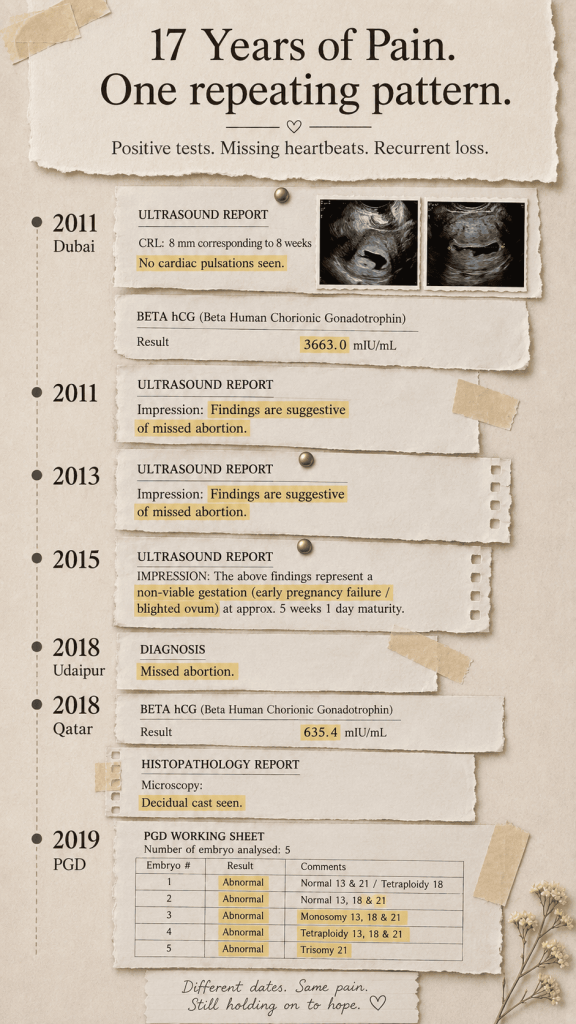
When this couple first came to us, they did not come with a simple infertility problem. They came with years of exhaustion, pain and unanswered questions. Before reaching Indore Infertility Clinic, they had already consulted 74 doctors across India, Qatar and UK. They had gone through 12 failed attempts. They had conceived naturally 8 times, but each pregnancy ended too early, usually between 6 to 8 weeks. They had also undergone IVF 4 times, with 4 failed embryo transfers. By the time they reached us, they were not looking for routine reassurance. They had already heard enough hopeful words. What they needed was a careful, honest review of their entire journey and a realistic way forward.
The Difficult Case

Their case was especially difficult because they had already tried almost everything that modern fertility treatment could offer. They had undergone detailed genetic testing, IVF with PGT, ERA testing, LIT therapy, and multiple rounds of evaluation and treatment across different centres in different countries, including leading clinics in Mumbai and London. Every possible explanation had been considered at some point, and yet no single clear cause had been found. Eventually, their condition carried the label of unexplained recurrent pregnancy loss. It is an ironic and painful term, because “unexplained” is not truly an answer. It is the point at which science admits that the cause has not yet been identified, while the couple continues to live with the full emotional weight of every loss.
Sometimes, even an abnormal report at least gives the couple a direction. It tells us what we may be dealing with and what we may need to target. But when all major reports are normal and the losses still keep happening, the situation becomes far more subjective and emotionally confusing. There is a very thin line between continuing to try again with the same approach and accepting that it may be time to consider a different path, such as surrogacy. When there is no clear answer, there is no clear target to
Each Failure looked like a hurdle

For them, getting pregnant was never a problem. The real problem was continuation of pregnancy. A positive pregnancy test had come many times before, but the joy was always short-lived. Each time, hope would begin again, only to end within a few weeks. Over time, even a positive test had stopped feeling like celebration. It had become a moment mixed with fear, because they had seen the same story repeat too many times. In such cases, the emotional burden is very different from conventional infertility. The couple does not just fear failure. They fear hope itself.
When they came to us, the first step was not to rush into another IVF cycle or another test. We paused and reviewed their history carefully. We looked at their natural conceptions, early pregnancy losses, previous IVF cycles, embryo transfer details, PGT reports, ERA report, immunological treatments, medical history, uterine evaluation, and the pattern of pregnancy loss. In complex fertility journeys, the most important question is not always “What else can we do?” Sometimes the more important question is “What should we stop repeating blindly?” They had already done enough. What they needed now was not more treatment for the sake of treatment, but a different and carefully reasoned direction.
After detailed counselling, surrogacy was discussed as one possible pathway. It was not presented as an easy shortcut, because surrogacy is never a small decision. It requires medical clarity, legal compliance, emotional readiness, family understanding, and trust in the treating team. For this couple, the decision carried even more weight because they had already gone through years of pregnancy losses, failed embryo transfers, repeated investigations, and treatment fatigue. Surrogacy was therefore discussed not as a desperate last attempt, but as a medically reasoned option after a long history of unexplained recurrent pregnancy loss and repeated failed outcomes despite advanced treatments.
The other road

After taking time to understand the process, the couple decided to explore surrogacy as the next step. Their journey with us began in December 2024, but the treatment did not begin immediately. Surrogacy is not just a medical decision. It also involves legal, ethical, emotional, and family-level clarity. The couple was counselled in detail about the legal framework and the required formalities. After understanding the process, they brought a family member who was willing to become the surrogate mother for them.
The surrogate mother then underwent a detailed medical evaluation to ensure that she was physically fit and suitable for pregnancy. Along with this, all required legal documentation and formalities were completed. This process itself took almost six months, because in surrogacy, the medical plan can move forward only after the legal and clinical requirements are properly fulfilled. Once everything was in place, the IVF cycle was planned carefully. IVF with PGT-A was done, healthy embryos were identified, and the embryo transfer was planned for the surrogate mother with attention to timing, endometrial preparation, protocol, and medical safety.
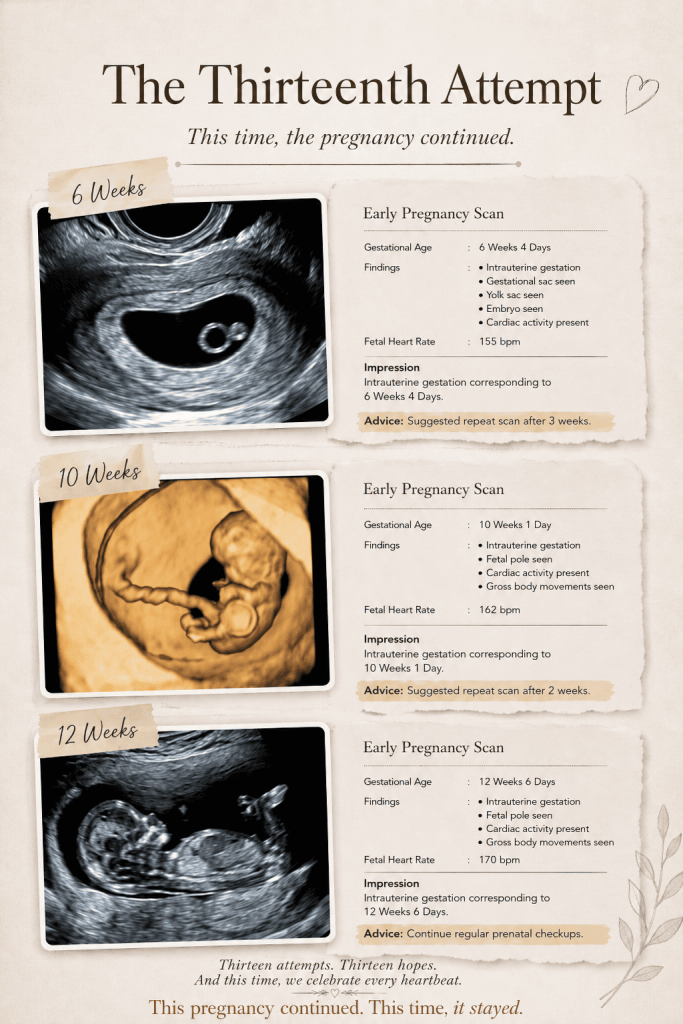
For the couple, this was not just another embryo transfer. This was their 13th attempt after 12 heartbreaks. Everyone involved understood the weight of that number. When the pregnancy test came positive, the couple was happy, but their happiness was guarded. They had seen positive tests before. For them, the real reassurance would come only when the pregnancy crossed the stage where previous pregnancies had stopped. Every scan mattered. Every heartbeat mattered. Every week that passed felt like a milestone. Slowly, the pregnancy moved beyond 6 weeks, then beyond 8 weeks, and then beyond the painful point where their earlier pregnancies had repeatedly ended. This time, the pregnancy continued smoothly. After an uneventful antenatal course, the surrogate mother delivered a healthy baby girl, bringing an end to a journey that had stretched across countries, clinics, treatments, losses, and years of unanswered questions.
The long road ahead (Legalities, Figuring Out)

Seventeen months after their first consultation with us, they finally held their baby in their arms. A healthy baby girl. After 74 doctors, 3 countries, 8 early pregnancy losses, 4 failed embryo transfers, and 12 failed attempts, their 13th attempt finally became their child. It was not just a medical success. It was the end of a very long emotional battle.
This story is important because it reminds us that recurrent pregnancy loss needs more than repeated treatment. It needs a complete review, honest counselling, and individualized planning. Not every couple with recurrent pregnancy loss needs surrogacy, and it would be wrong to suggest that. But in selected cases, especially when multiple pregnancies have failed to continue despite detailed evaluation and advanced treatments, surrogacy may become a meaningful option. The goal is not to do everything. The goal is to do the right thing next.
For this couple, success did not come from one dramatic discovery or one magical test. It came from changing direction when the previous road had caused too much pain. It came from careful review, difficult decision-making, and the courage to try again differently. Their 13th attempt was not just another attempt. It was the moment when a long history of loss finally gave way to life, hope, and their daughter.
The Complete Family