
If you’re considering egg donation as a path to motherhood, you’re not alone. Thousands of women in India each year turn to egg donation when their own eggs are not viable, providing hope and possibility where other fertility treatments haven’t succeeded. At our Indore infertility clinic, we’ve successfully helped hundreds of families achieve their dreams through donor egg IVF programs.
Whether you’re facing advanced maternal age, low egg quantity or quality, genetic concerns, or previous failed IVF cycles, egg donation offers a realistic path forward. In this comprehensive guide, we’ll explain everything you need to know about egg donation in Indore, including the process, costs, success rates, legal aspects, and real success stories from our patients.
What is Egg Donation and Who Needs It?
Egg donation is an assisted reproductive technique where eggs from a healthy, fertile donor are used for IVF treatment. Your partner’s sperm (or donor sperm) fertilizes the donor eggs in the laboratory, and the resulting embryos are transferred into your uterus. Although the baby won’t be genetically related to the mother, you get to experience pregnancy and childbirth.
What makes egg donation different from other fertility treatments is that it bypasses any issues with egg quality or quantity, dramatically improving success rates. In fact, egg donation has some of the highest success rates in all of assisted reproductive technology—sometimes reaching 60-75% per cycle, regardless of the recipient mother’s age.
Who Benefits from Egg Donation?
- Women with advanced maternal age (40+) with poor egg quality
- Premature ovarian failure or early menopause
- Low AMH (Anti-Müllerian Hormone) levels indicating low ovarian reserve
- Women with genetic disorders they don’t want to pass to children
- Multiple failed IVF cycles with poor egg quality
- Patients with cancer history who underwent chemotherapy or radiotherapy
- Single women or same-sex couples
- Women with absent or non-functional ovaries
Egg Donation Success Rates: Why They’re So High
One of the most compelling reasons to choose egg donation is the significantly higher success rates. Here’s why egg donation works so well:
Eggs come from young, healthy donors (typically ages 21-32) with excellent ovarian reserve and egg quality. Success depends primarily on egg quality—not on the age of the recipient mother. Even women in their 50s have achieved successful pregnancies with donor eggs.
Egg Donation Success Rate by Age of Recipient:
| Recipient Age | Success Rate Per Cycle |
| Under 35 years | 65-75% |
| 35-40 years | 60-70% |
| 40-45 years | 55-65% |
| 45-50 years | 45-55% |
| Over 50 years | 35-54% |
The Egg Donation Process Step-by-Step
Understanding the process helps alleviate anxiety and helps you prepare. Here’s what to expect when pursuing egg donation at our Indore infertility clinic.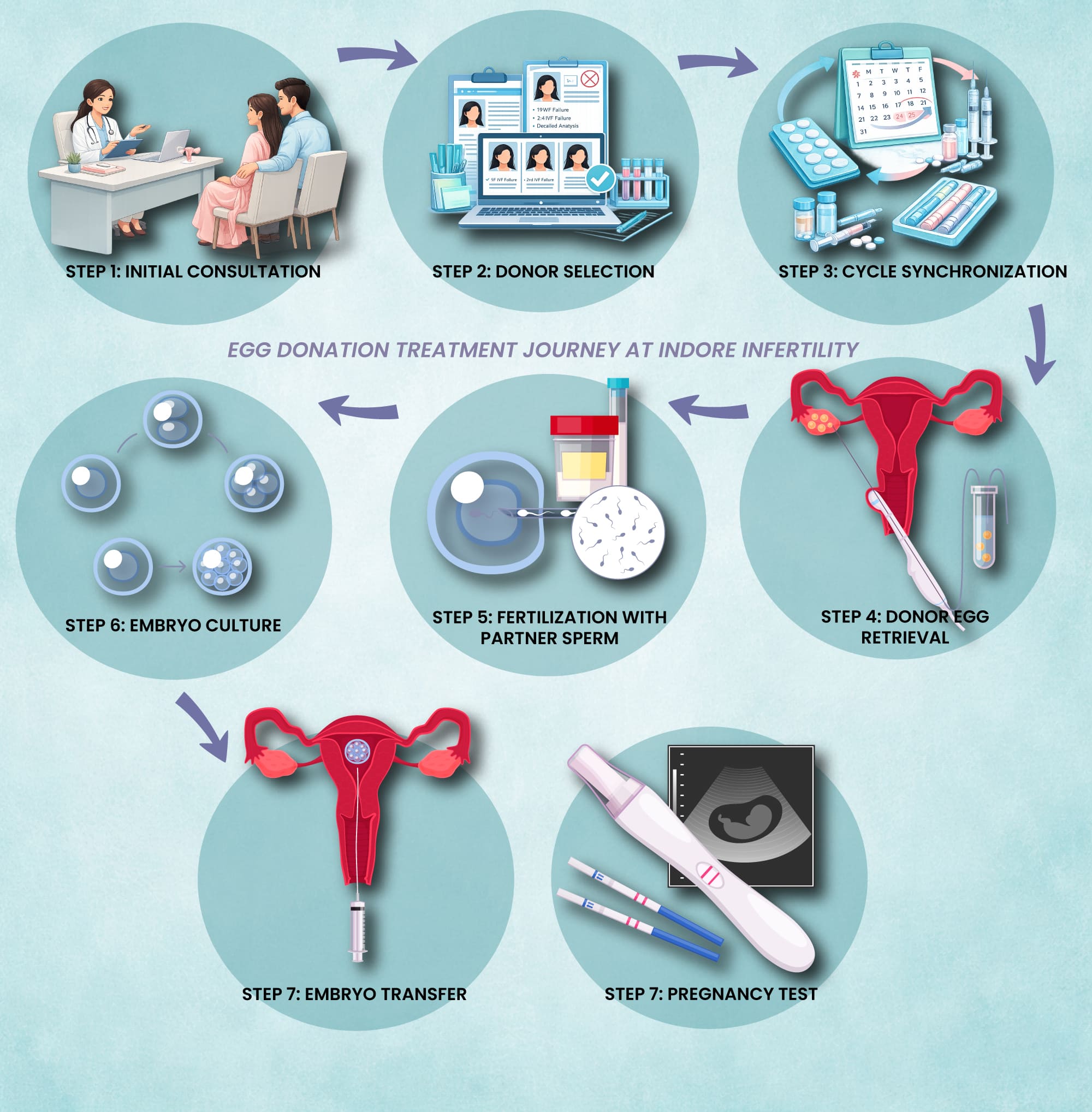
Step 1: Initial Consultation and Evaluation
Your fertility journey begins with a detailed consultation. We discuss your medical history, perform ultrasound and blood tests to assess your uterine health and hormone levels, and ensure your body is ready for pregnancy. Unlike egg retrieval, you don’t need excellent ovarian reserve—we’re only checking that your uterus is healthy and receptive to embryo implantation.
We also discuss psychosocial aspects of using donor eggs and provide counseling about bonding with a non-genetically related child. This is an important conversation we don’t skip over.
Step 2: Donor Selection and Matching
Our Indore infertility clinic maintains a carefully screened database of healthy, fertile egg donors. Donors undergo extensive evaluation including:
- Age verification (21-32 years old)
- Complete medical and family history
- Infectious disease screening (HIV, Hepatitis B/C, syphilis, etc.)
- Psychological evaluation
- Genetic screening and counseling
- Ovarian reserve assessment
- Physical examination
We assist you in selecting a donor based on your preferences—physical characteristics, educational background, professional achievements, medical history, and personality traits. Donor profiles include detailed information to help you find a good match. The donor’s identity remains confidential throughout the process.
Step 3: Synchronizing Cycles
Once a donor is selected, we synchronize the menstrual cycles of the donor and recipient. The donor begins ovarian stimulation to produce multiple eggs while you prepare your endometrium (uterine lining) to receive an embryo. This typically takes 10-14 days. We use hormonal medications (birth control pills initially, then gonadotropins) to time everything perfectly so eggs and uterus are ready simultaneously.Step 4: Donor Egg Retrieval
While the donor undergoes egg retrieval (a 20-30 minute minimally invasive procedure), you’re home taking your medications. The retrieved eggs are immediately taken to our embryology laboratory for processing. Donors are given time to recover with minimal discomfort thanks to modern anesthesia techniques.Step 5: Fertilization
The donor eggs are fertilized with your partner’s sperm (or donor sperm if needed). Most donor eggs are of such high quality that fertilization rates are excellent—typically 70-80% of eggs fertilize normally.Step 6: Embryo Culture
Fertilized embryos are cultured in specialized media in our laboratory incubators. We monitor their development daily. By day 3 or 5, we can assess which embryos are developing normally. Because donor eggs are high quality, you often have multiple good embryos to choose from.Step 7: Embryo Transfer
When your endometrium is ready, we transfer one or two of the best embryos into your uterus. This is a simple, non-invasive procedure done in our clinic without anesthesia. The procedure takes just 5-10 minutes. You can return to normal activity afterward.Step 8: Pregnancy Test
Fourteen days after embryo transfer, you’ll return for a blood test to check for pregnancy hormones (beta-hCG). This is the moment of truth. If positive, you’ll undergo an ultrasound at 5-6 weeks to confirm the pregnancy is in the uterus and developing normally.Egg Donation Cost in Indore: Complete Breakdown
Egg donation is more expensive than standard IVF due to the additional costs of donor screening, compensation, and coordination. However, Indore remains significantly more affordable than major cities.| Cost Component | Cost (INR) |
| Donor Selection & Matching | ₹15,000 – ₹25,000 |
| Donor Cycle Coordination & Management | ₹20,000 – ₹30,000 |
| Donor Egg Retrieval | ₹20,000 – ₹30,000 |
| Recipient Endometrial Preparation (Hormones & Monitoring) | ₹15,000 – ₹25,000 |
| Fertilization & Embryo Culture | ₹15,000 – ₹25,000 |
| Embryo Transfer | ₹12,000 – ₹18,000 |
| TOTAL EGG DONATION CYCLE | ₹2,75,000 – ₹3,25,000 |
Legal and Regulatory Framework in India
Egg donation in India is governed by the Assisted Reproductive Technology (Regulation) Act, 2021, and the Surrogacy (Regulation) Act, 2021. Understanding these regulations provides important protections:- Donors must be altruistic: No payment is given ‘for’ eggs; donors receive only reimbursement of medical and travel expenses
- Donor anonymity: Donor and recipient identities are completely confidential
- Clinics must be registered: Only clinics registered with the National ART Board can legally perform these procedures
- Donation limit: Each donor can donate a maximum of 7 times in her lifetime to protect her health
- Consent required: Complete informed consent from both donor and recipient is mandatory
- Psychological counseling: Both parties must receive counseling before proceeding
Real Success Stories from Our Indore Clinic
Priya’s Story: Hope After Age 45
Priya came to us at age 47, having tried natural conception for 8 years. Her AMH was nearly undetectable, indicating virtually no viable eggs remained. Using her own eggs, her chances of success were less than 1%. She chose egg donation. On her first cycle with a donor egg, she conceived twins. Today, her beautiful 4-year-old twins are thriving. ‘I never thought I’d be a mother,’ Priya told us. ‘Egg donation gave me the most precious gift.’
Rahul and Sneha: Three Beautiful Children
Sneha had premature ovarian failure diagnosed at age 32 and had been told she could never have biological children. After initially struggling with the emotional aspect of egg donation, she and her husband chose to proceed. Their first egg donation cycle resulted in pregnancy with their daughter. From the leftover frozen embryos, they had two more successful transfers, giving them three healthy children. ‘It’s been the greatest blessing of our life,’ Rahul shared during their last follow-up.
Deepa’s Second Chance
Deepa had undergone five failed IVF cycles with her own eggs over 6 years before coming to us. Her hormone levels indicated poor egg quality. We recommended egg donation. She was initially reluctant, fearing it wouldn’t feel like ‘her’ child. During counseling, she processed these feelings and felt ready to proceed. She conceived on her first egg donation cycle. Now, holding her 18-month-old daughter, Deepa says, ‘I don’t feel any different about her. She’s entirely mine. This was the right decision.’
Emotional and Psychological Aspects of Egg Donation
It’s completely natural to have feelings about using donor eggs. Many women initially feel a sense of loss—grieving that they won’t pass on their genetics. Others worry whether they’ll bond with a non-genetically related child. These feelings are valid and important to process.
This is why psychological counseling before and after egg donation is essential. At our Indore infertility clinic, we provide comprehensive counseling by experienced fertility psychologists. They help you:
- Process emotions about infertility and genetic loss
- Understand that genetic connection isn’t the only bond
- Prepare for disclosure conversations if you choose to tell your child
- Build confidence and excitement about motherhood
Research confirms that children born from egg donation develop normally and have no greater psychological issues than naturally conceived children. The genetic connection matters less than we often believe; love, nurturing, and presence matter infinitely more.
Frequently Asked Questions About Egg Donation
Children don't always look like their biological parents anyway! Genetics is complex. Your child will inherit genes from the donor and the sperm provider. If your partner's sperm is used, the child will have some of his features. You'll also shape your child's appearance through pregnancy hormones and nutrition. Most importantly, the genetic connection matters far less than the love and care you provide.
Egg donation is completely different from surrogacy. With egg donation, you carry the pregnancy, experience it, and give birth to your own child. You provide the womb, nutrition, and prenatal environment. With surrogacy, another woman carries the pregnancy for you. Egg donation is significantly less expensive and complex than surrogacy.
While egg donation has excellent success rates (60-75%), not everyone conceives on the first attempt. You may have frozen embryos remaining from your cycle to try again at lower cost. If unsuccessful with one donor's eggs, you can try with a different donor. Our clinic discusses contingency plans upfront.
This is a personal decision. Some families choose to tell, others don't. There's no right or wrong answer. Our counsellors help you think through what's right for your family. Research shows that children who are told age-appropriately handle it well, especially when presented positively—'we loved you so much we got help to have you.'
Yes, within legal limits. You can match on physical appearance, ethnicity, educational background, professional achievement, and personality traits. You cannot select for sex, genetic traits, or other characteristics beyond the donor's profile. Our clinic helps you find donors matching your preferences from our extensive database.
Donors are screened for genetic disorders and family history of genetic conditions. Genetic risks are minimal because donors are young and healthy. Optional advanced genetic testing (PGD/PGT) can screen embryos for chromosomal abnormalities before transfer, further reducing risk.
From your initial consultation to pregnancy test takes approximately 4-6 weeks. Initial evaluation takes 1-2 weeks, donor matching takes 1-2 weeks, cycle coordination and stimulation take 2-3 weeks, and the two-week wait to pregnancy testing completes the cycle. This timeline can be quicker or slower depending on individual circumstances.
Yes! Some clinics maintain frozen egg banks. Frozen donor egg cycles cost ₹1,50,000-₹1,80,000, significantly less than fresh donor cycles. Pregnancy rates with properly frozen and thawed eggs are comparable to fresh eggs. This is an excellent cost-effective option.
Egg donation opens doors to motherhood for thousands of women. If you’re facing infertility due to egg quality or quantity issues, don’t lose hope. At our Indore infertility clinic, we’re here to guide you through every step of this journey with compassion, expertise, and proven success. Contact us today to explore whether egg donation is right for you.